Jupiter scaled one in one billion
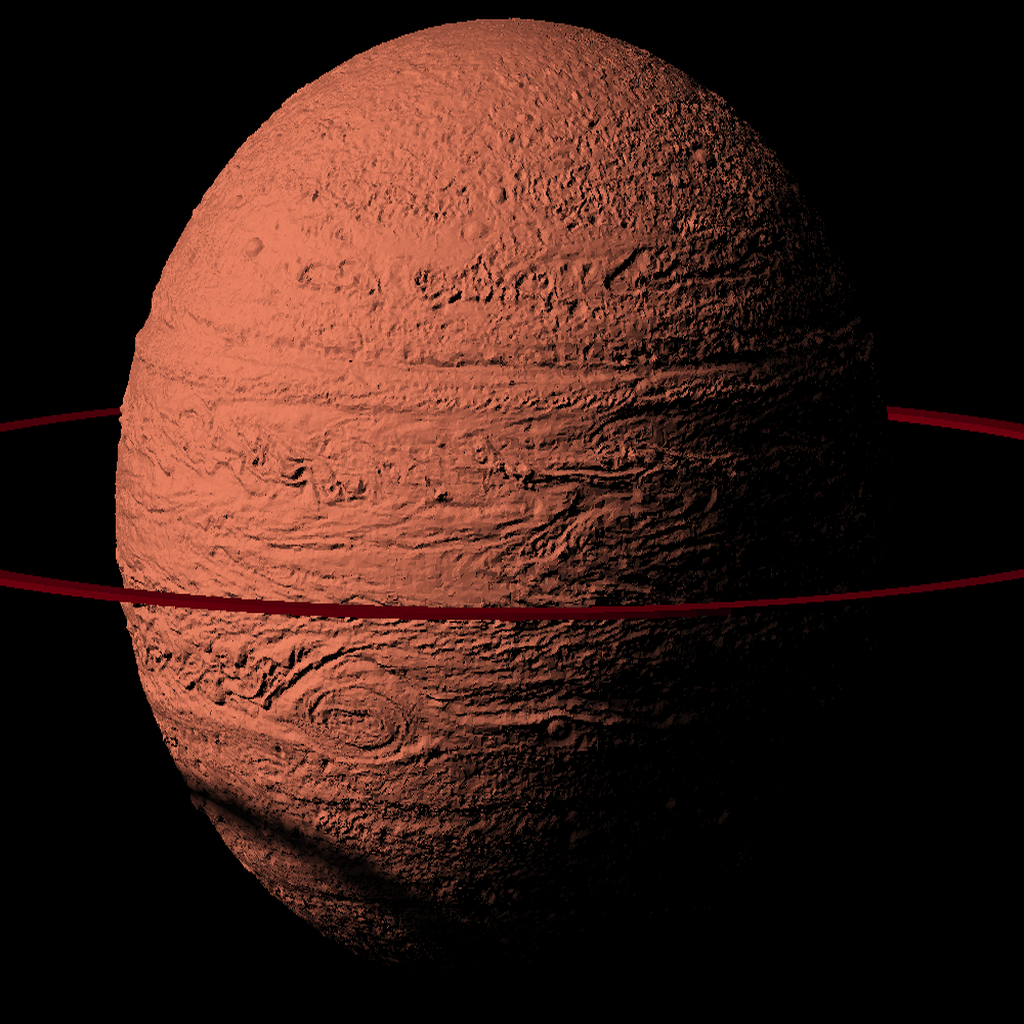
As well as my other posts on gas giants, this is not a true relief of the surface of Jupiter, because it has not a solid surface, but it is instead a interpretation of the height of the clouds as proportional to the albedo (brightness). Contrary to my posts of Uranus and Neptune, in which I've used high contrasted images and mosaics of the planets, with Jupiter I used a global map in true color, that I high-passed to keep only the "turbulence" of the atmosphere, discarding the bright level of some bands. As well with the other gas planets, the clouds moves and the bands of atmosphere rotate at different spins, so the map is valid for the moment the photos were taken. It was modelled using MATLAB R2016a. The model is scaled one in one billion, or one in one thousand million in the long scale system. In this scale, the Earth is about 1cm in diameter. The ring system of Jupiter is far reduced when compared with that of Saturn, even with the one of the ice giants. Here it is simplified to the main ring only.
The file's names explained: name_1_x_10_y.stl is 1 : x * 10y. So _1_6_10_7 is 1:600000000 or one in 60 million.

Jupiter

Jupiter is the biggest and most massive planet in the Solar System. It is so massive that the barycenter between the Sun and Jupiter lays outside the star. It is also the faster in rotational period, taking less than 10 hours to do a jovian day. Jupiter is known for being a sort of "vacuum cleaner" of the Solar System, scattering small asteroids from their orbits into a high unstable one. This is true also for comets. Small interactions in the high eccentrical orbit of a comet could make their orbital parameters change drastically, slowing down to a smaller Jupiter-resonant orbit, or accelerating them to the point they escape from the Solar System. This is thought to be an important factor in the search of life conditions among exoplanets. A big Jupiter sized planet could help to clean the system of potentially hazardous asteroids for an Earth like planet of that system. The most noticeable feature of the jovian surface is the Great Red Spot, a storm of the size of the Earth on the southern hemisphere. It has four big satellites, the Galileans Moons: Io, Europa, Ganymede and Callisto. The biggest one, Ganymede, is bigger, but lighter, than the planet Mercury. The rest of the moons are far smaller (like Amalthea, Thebe and Himalia), and they have not the enough mass to be rounded.
  • Type: Planet. Gas giant.
  • Orbit: Sun.
  • Orbital period: 11.862 yr.
  • Rotational period: 9 h 55 min 30 s.
  • Composition: Hydrogen, helium atmosphere; metalic hydrogen mantle, rocky core.
  • Density: 1.326 g/cm3.
  • Dimensions: 142984 km × 133708 km
  • Model scale: 1:5x10⁸ (28cm) 1:1x10⁹ (14cm)

References

Other astronomical objects

Object

Scale [1:x]

K = 103 (thousand)
M = 106 (million)
G = 109 (billion)

Image

Inner Solar System

Mercury 20M, 60M, 120M image
Venus 60M, 120M, 250M image
Earth 60M, 120M, 250M image
Luna 10M, 20M, 60M image
Mars 20M, 60M, 120M image
Phobos and Deimos 200K, 500K image

Man-made

Salyut 7 40, 48, 80, 160 image

Near Earth Asteroids

Moshup and Squannit 8K, 20K, 40K image
Ra-Shalom 20K, 40K image
YORP 1K, 3K image
Castalia 8K, 20K, 40K image
Bacchus 8K, 20K image
Bennu 3K, 8K image
Ryugu 3K, 8K, 20K image
Geographos 40K, 80K image
Phaethon 40K, 80K image
Itokawa 3K, 8K image
Eros 80K, 200K, 500K image
Nereus 3K, 8K image
Didymos and Dimorphos 8K, 20K image
Mithra 20K, 40K image
Golevka 8K image
Toutatis 40K, 80K image

Main Asteroid Belt

Gaspra 200K image
Annefrank 40K, 80K image
Braille 20K, 40K image
Vesta 2M, 4M, 10M image
Šteins 40K, 80K, 200K image
Iris 2M, 4M image
Hebe 1M, 2M, 4M image
Lutetia 500K, 1M, 2M image
Julia 1M, 2M, 4M image
Mathilde 500K, 1M image
Juno 2M, 4M image
Ceres 4M, 10M image
Pallas 4M, 10M image
Kleopatra 2M, 4M image
Ida 500K, 1M image
Psyche 2M, 4M image
Interamnia 2M, 4M image
Elektra 1M, 2M, 4M image
Hygiea 2M, 4M, 10M image
Antiope 1M, 2M image

Jovian System

Jupiter 500M, 1G image
Amalthea 2M, 4M image
Thebe 1M, 2M image
Io 20M, 60M image
Europa 20M, 60M image
Ganymede 60M, 120M image
Callisto 60M, 120M image

Saturn System

Saturn 500M, 1G image
Pan, Daphnis and Atlas 80K, 200K, 500K, 1M image
Prometheus and Pandora 1M, 2M image
Janus and Epimetheus 2M, 4M image
Mimas 2M, 4M, 10M image
Methone, Anthe and Pallene 40K, 80K image
Enceladus 4M, 10M image
Tethys 4M, 10M, 20M image
Telesto and Calypso 200K, 500K image
Dione 4M, 10M, 20M image
Helene 500K, 1M image
Rhea 10M, 20M image
Titan 60M, 120M image
Hyperion 2M, 4M image
Iapetus 10M, 20M image
Phoebe 1M, 2M, 4M image

Uranian System

Uranus 250M, 500M, 1G image
Puck 1M, 2M, 4M image
Miranda 4M, 10M image
Ariel 10M, 20M image
Umbriel 10M, 20M image
Titania 10M, 20M image
Oberon 10M, 20M image

Neptunian System

Neptune 250M, 500M, 1G image
Larissa 2M, 4M image
Proteus 2M, 4M, 10M image
Triton 20M image

Comets

Tempel 1 40K, 80K, 200K image
Wild 2 40K, 80K image
Churyumov-Gerasimenko 20K, 40K, 80K image
Hartley 2 20K, 40K, 80K image
Borrelly 40K, 80K, 200K image
Halley 80K, 200K image

Centaurs and TNOs

Hidalgo 500K, 1M image
Chariklo 2M, 4M image
Pluto and Charon 10M, 20M image
Styx, Nix, Kerberos and Hydra 500K, 1M image
Haumea, Namaka and Hiʻiaka 10M, 20M image
Arrokoth 200K, 500K, 1M image
Largest TNOs and their moons 10M, 20M image

Extrasolar

Exoplanets 120M, 250M, 500M image
Nearest white dwarfs 120M, 250M image
HD 189733 b 1G image
Pulsars 200K, 500K image
Cygnus X-1 accretion disk 10M, 20M image
Homunculus Nebula 2*1016, 4*1016, 1.2*1017 image
M87* photon ring 1.5*1014 image

Sky maps

Heliosphere 7.5*1013, 1.5*1014 image
Constellations - image
CMBR 2*1028 image

Ancient

Earth (540 Mya to 20 Mya) 60M, 120M, 250M image
Luna (4 Gya) 20M, 60M image

Speculative

Planet Nine 250M, 500M image
Cube planet 60M, 120M, 250M image

Science Fiction

Ghroth 4M, 10M image
Arda 60M, 120M image
Life Foundation rocket 160, 200, 350, 500 image
B612 10, 20, 32, 40 image
Mesklin 500M, 1G image
Arrakis 60M, 120M image
Borg cube 8K, 20K, 40K image
Pern 60M, 120M image
Europa Monolith 200K, 500K image
Leonora Christine 500, 600, 1K, 3K image
Rama 80K, 200K, 500K image
Tatooine 60M, 120M image
Death Star 500K, 1M, 2M image
Starkiller Base 2M, 4M, 10M image
Z-95 40, 80, 160, 200 image
Eternia 60M, 120M image
Rocheworld 20M, 60M image
Visitors mothership 20K, 40K image
Wheel of Time Earth 60M, 120M, 250M image
Nirn, Secunda and Masser 20M, 60M, 120M image
ID mothership 2M, 4M, 10M image
ID troop transporter 200, 350, 500, 600, 1K image
Heptapod spaceship 1K, 3K, 8K image
Gaijin flowership 3K image
Red Moon 60M, 120M image
Halo Array 4M, 10M, 20M, 60M image
Gem Homeworld 120M, 250M, 500M image
Citadel of Ricks 200K image
The Skeld 40, 80, 160, 200, 350, 500, 1K image
Jean Jacket 350, 500, 600, 1K image

Misc

Mars (1962 reconstruction) 60M, 120M image
Flat Earth 250M image
Expanding Earth 60M, 120M image
Spaceship of Ezekiel 80, 160 image