Styx, Nix, Kerberos and Hydra scaled one in one million
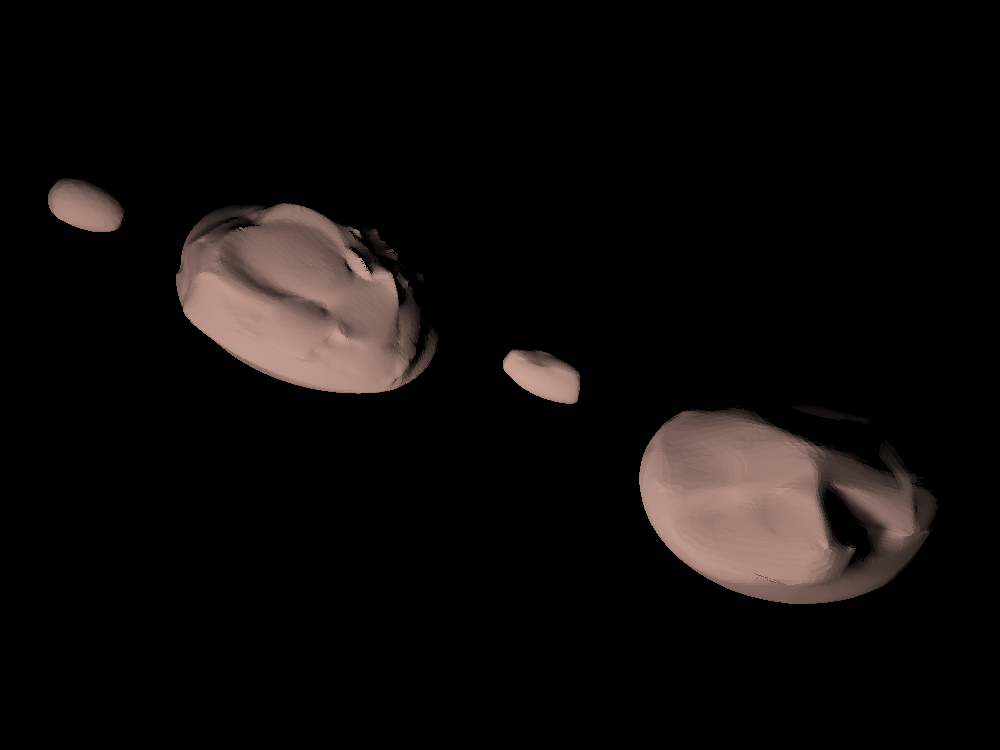
These are the models Styx, Nix, Kerberos and Hydra, the moons of Pluto other than Charon, sorted by distance to Pluto. They were made using MATLAB R2016a on several images of the moons from the New Horizons mission. Pluto and Charon can be make in the same scale but not as the other smaller moons. Nix has three good photos which I used to "triangule" the topography; Hydra has two good pictures, so some of the shape can be guessed. For the two smaller moons, Styx and Kerberos, the model was made interpolating their contour.
The file's names explained: name_1_x_10_y.stl is 1 : x * 10y. So _1_6_10_7 is 1:600000000 or one in 60 million.
Warning: these models are (or may be) the firsts published shape models of these moons, based on available data. Although the methods nor the results weren't approved by any relevant researcher, the models were made by my hand; so if you use, print, or publish them in any site, it would be apreciated if you give me the proper credit for the models.
All four moons are similar to each other. They orbit the Pluto-Charon barycenter which is the same as the entire system. The Pluto System was created by a collisional event between two similar sized Trans Neptunian Objects. Most of the material ejected from Pluto accreated into Charon, like with the Earth-Moon system. The other four moons seems to be fragments, or stacks of fragments, from this material. They have very circular an low inclined orbits (coplanar with the Pluto-Charon orbit) and all the moons are locked in a near resonance with Charon of 1:3:4:5:6. Pluto and Charon are tidal locked, which means that they are always facing the same side to each other; but the rest of the moons, unlike most of the Solar System moons, not locked this way. They rotate chaotically, which means that their rotational axis tumble, changing its direction, speed and even fliping upside down entirely (making it retrograde). This is because the asimetrical gravitational atraction from Charon and Pluto.
The file's names explained: name_1_x_10_y.stl is 1 : x * 10y. So _1_6_10_7 is 1:600000000 or one in 60 million.
Warning: these models are (or may be) the firsts published shape models of these moons, based on available data. Although the methods nor the results weren't approved by any relevant researcher, the models were made by my hand; so if you use, print, or publish them in any site, it would be apreciated if you give me the proper credit for the models.
All four moons are similar to each other. They orbit the Pluto-Charon barycenter which is the same as the entire system. The Pluto System was created by a collisional event between two similar sized Trans Neptunian Objects. Most of the material ejected from Pluto accreated into Charon, like with the Earth-Moon system. The other four moons seems to be fragments, or stacks of fragments, from this material. They have very circular an low inclined orbits (coplanar with the Pluto-Charon orbit) and all the moons are locked in a near resonance with Charon of 1:3:4:5:6. Pluto and Charon are tidal locked, which means that they are always facing the same side to each other; but the rest of the moons, unlike most of the Solar System moons, not locked this way. They rotate chaotically, which means that their rotational axis tumble, changing its direction, speed and even fliping upside down entirely (making it retrograde). This is because the asimetrical gravitational atraction from Charon and Pluto.
(134340 Pluto 5) Styx
- Type: Satellite.
- Orbit: Pluto.
- Orbital period: 20.161 d.
- Rotational period: 3.24 d. Chaotic rotation.
- Composition: Icy body.
- Density: ? g/cm3.
- Dimensions: 16 km × 9 km × 8 km.
- Model scale: 1:5x10⁵ (3.2cm) 1:1x10⁶ (1.6cm)
(134340 Pluto 2) Nix
- Type: Satellite.
- Orbit: Pluto.
- Orbital period: 24.854 d.
- Rotational period: 1.829 d. Chaotic rotation.
- Composition: Icy body.
- Density: 1.37 g/cm3.
- Dimensions: 49.8 km x 33.2 km x 31.1 km.
- Model scale: 1:5x10⁵ (10cm) 1:1x10⁶ (5cm)
(134340 Pluto 4) Kerberos
- Type: Satellite.
- Orbit: Pluto.
- Orbital period: 32.167 d.
- Rotational period: 5.31 d. Chaotic rotation.
- Composition: Icy body.
- Density: ? g/cm3.
- Dimensions: 19 km × 10 km × 9 km.
- Model scale: 1:5x10⁵ (4cm) 1:1x10⁶ (2cm)
(134340 Pluto 3) Hydra
- Type: Satellite.
- Orbit: Pluto.
- Orbital period: 38.202 d.
- Rotational period: 10.31 h. Chaotic rotation.
- Composition: Icy body.
- Density: 2.13 g/cm3.
- Dimensions: 50.9 km × 36.1 km × 30.9 km.
- Model scale: 1:5x10⁵ (4cm) 1:1x10⁶ (2cm)


